Bodybuilding Always Does You Good: What a Judge Sees from Below the Stage
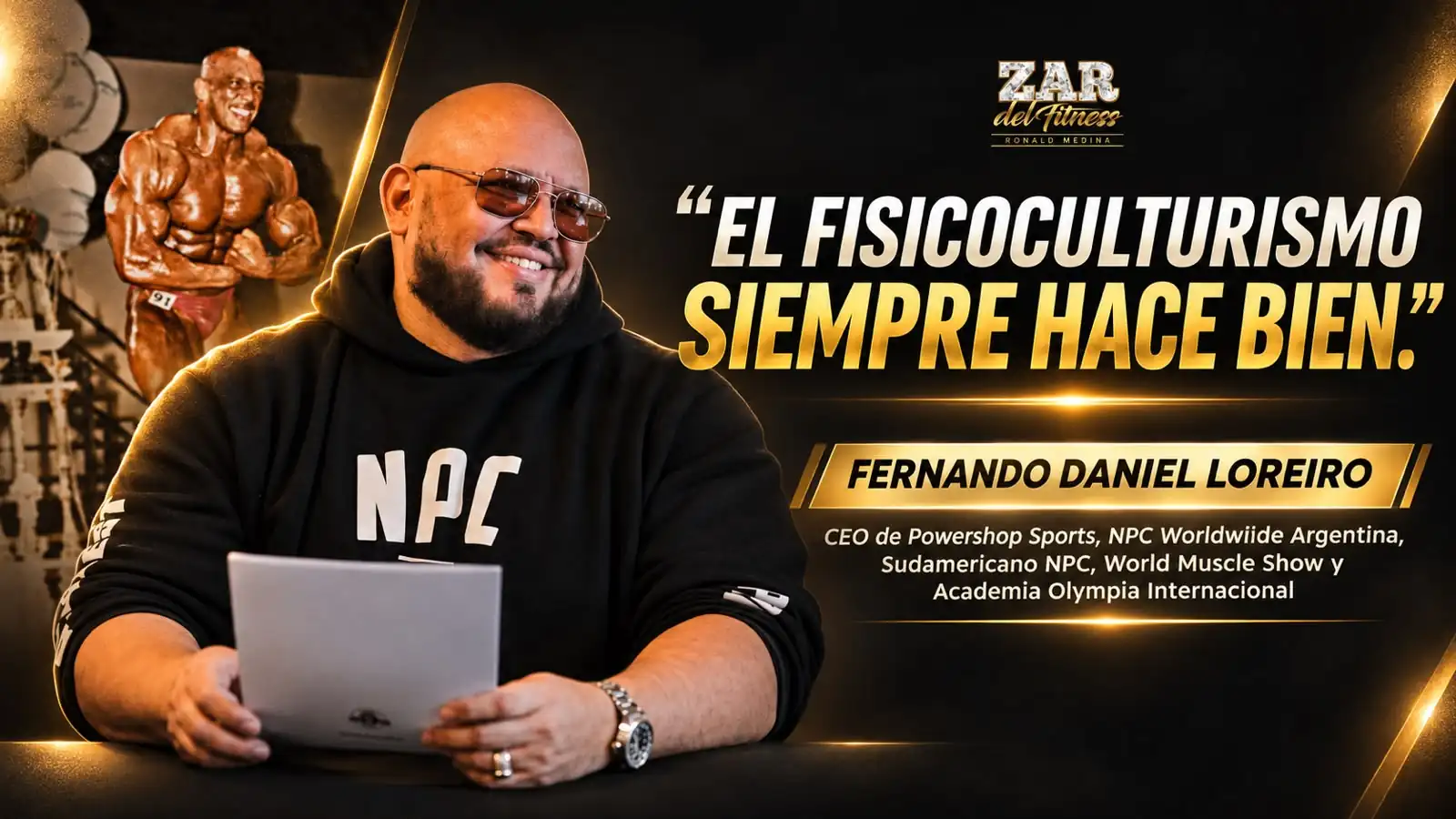
Before handing the floor to Fernando, a brief reflection: almost everything we know today as fitness was born from bodybuilding. Training routines, eating with a goal and even gyms as we know them were first tested on a bodybuilder's body. My work as a coach rests on that foundation, and that's why I have enormous respect for it. Talking with Fernando Loreiro on Detrás del Espejo made me see it with even deeper respect. What follows is his view, in his own words.
— Ronald Medina
I was 10 when, walking past a newsstand in Almagro, I saw a bodybuilding magazine for the first time. I didn't know what it was. The physiques looked like comic-book heroes, real-life superheroes. I bought it, took it to my Catholic school and nearly got excommunicated. But something lit up that day.
Between 10 and 14 I read everything I could find and knocked on the door of every club I knew. "How old are you? Twelve? You can't." Until a rugby friend took me to a neighborhood gym, the kind we called "caves", and that's where I started. Every time I lifted a weight I felt I was getting closer to that magazine. By 19 I was competing.
Then came the years as an athlete, as a coach, the training as a judge and organizing events. Looking back today, I want to tell you how I see this sport from each of those places.
What a judge really looks at
When I sit down to judge, I don't know your story. I only evaluate what I see on stage. And what I look for rests on a three-legged table:
- Muscle mass, according to what each division calls for.
- The X-frame: broad shoulders, a small waist and legs in proportion with the torso.
- Conditioning: low body fat, with visible muscles.
Then come the details that complete the whole: color, shine, presentation, the way you pose. And that's where bodybuilding becomes what it truly is to me: a sport that is also an art.
An art that has to reach your heart
Since the first competitions in the early 1900s, this sport has drawn on Greek and Roman aesthetics. Posing follows a beautiful logic: show your strengths and hide your weaknesses. Building a physique, showing it, linking a routine to the rhythm of the music… and making it reach the audience. When it reaches the heart of whoever is watching, you've got a future star.
Some kids have it from day one. They make mistakes, you can see their inexperience, but they have an aura, a charisma. You spot it right away.
Everyone on stage is fighting their own battle
For some, setting a competition date is the first step toward the Mr. Olympia. For others, who may have been overweight or were going through hard times, it's a personal goal: "I made it on stage and I'm much better than I was six months ago."
That person may not be at the level we're used to. But they're fighting a different battle, and bodybuilding gives them a stage to show it. That's why I also see this sport as a tool for reaching personal goals.
That's why, as a judge, I would never tell anyone "this isn't for you". This sport always makes you better. Training makes you better and eating well makes you better. Maybe you weren't born with a perfect X-frame, but if you add muscle to what you have, you'll look better. Not every footballer is the number 10, but they all play. Everyone finds their place on the field.
Knowing how to lose is part of the journey
After a demanding prep, sometimes the result isn't what you expected. Not accepting it and saying "I'll improve for next time" is one thing. Being a sore loser is another.
That's what feedback is for: athletes can ask the judges for it and know exactly what to work on. Shoulders, waist, abdominal control, definition. That channel is there to help you grow, not to confront. And when I see someone with potential who didn't win, I tell them straight: "Keep going, because you've got what it takes to get to the top."
Health is non-negotiable
To anyone who tells me "I'm willing to lose everything for a title", my answer is this: as long as you have the desire, keep going. There will be fatigue. There will be a desert stretch, when meals get tighter and cardio goes up, and that's when discipline has to do its job.
But you don't sacrifice your health for anything. Your body has alarms that tell you "stop", and you have to listen to them, together with your coach and a health professional. As an organizer, if I see an athlete in poor condition, they don't compete. It's that simple.
And day to day, train well: with technique, with a plan and with focus. Leave your phone in your bag. That focus is what keeps you from getting injured and lets you keep doing this for many years.
Giving the opportunities I never had
There was a point in my career when I had the level to go further, but there was no federation to back me. That's why today, year after year, I make sure athletes from Argentina and the region have high-level events: a good theater, a good stage, a good photo. I have hardly any photos from my own competitions. I want them to have that memory.
I'd like to be remembered as someone who was an athlete, a coach, a judge and a promoter, and who gave the opportunities he never had.
Because after a whole life in this, there's one thing I'm sure of: when you practice it, everything can change for the better.
Bodybuilding always does you good.
Sincerely, Fernando Loreiro
Listen to the full conversation in the Detrás del Espejo episode with Fernando Loreiro.